Mail infrastructure
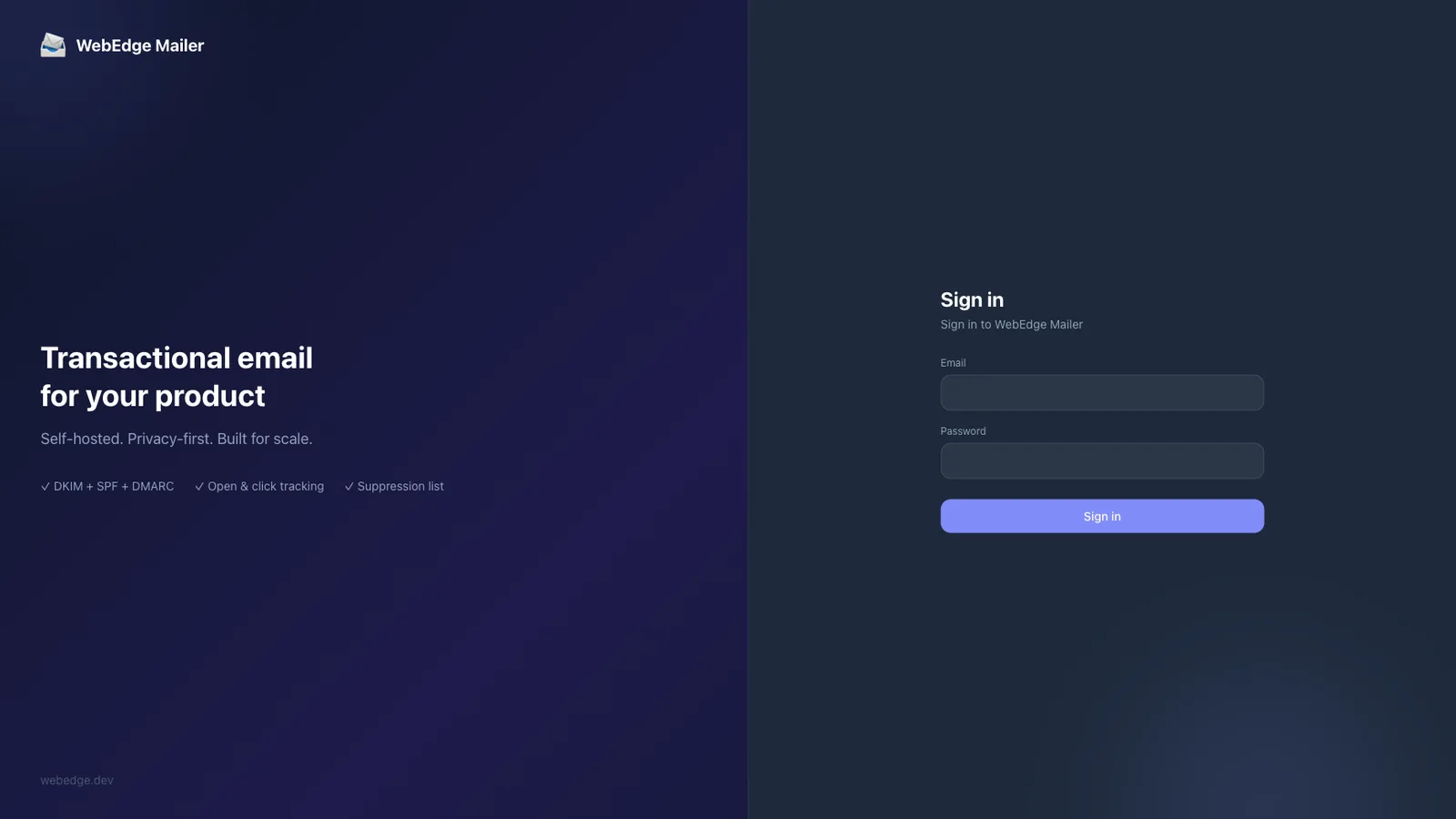
Our own email service — Postfix/OpenDKIM SMTP, DKIM-signed sends and campaigns across domains behind one API key.
 Dev-story
Challenge
Every product needed to send email — confirmations, alerts, campaigns — and we did not want each one wiring up SMTP, DKIM and a sender reputation on its own.
What we did
One mail service: an API that signs with DKIM, manages from-addresses and API keys, and handles transactional sends plus scheduled campaigns with open/click stats and automation triggers. Apps POST to `mailer.webedge.dev/api/v1/send` with a key.
Result
The calendar, ePokalbis and other apps send through this one service, and deliverability (DKIM, from-address) is managed in one place instead of per project.
Dev-story article
Mail infrastructure: how the project was built
Every app of ours needs to send email — codes, receipts, alerts, campaigns — and the usual answer is a third-party sender you cannot see into and pay per message. We wanted our own path: a real SMTP stack we run, DKIM-signed and multi-domain, behind a single API so no individual app ever touches SMTP.
Sections
05
Modules
04
Stack
Node.js + Postfix
Why the project exists
Every product needed to send email — confirmations, alerts, campaigns — and we did not want each one wiring up SMTP, DKIM and a sender reputation on its own.
Every app of ours needs to send email — codes, receipts, alerts, campaigns — and the usual answer is a third-party sender you cannot see into and pay per message. We wanted our own path: a real SMTP stack we run, DKIM-signed and multi-domain, behind a single API so no individual app ever touches SMTP.
What was built
One mail service: an API that signs with DKIM, manages from-addresses and API keys, and handles transactional sends plus scheduled campaigns with open/click stats and automation triggers. Apps POST to `mailer.webedge.dev/api/v1/send` with a key.
It started as an own-SMTP core (Postfix + OpenDKIM + a REST API), grew into a professional v2 service, and then a v3 with multi-domain support, a Vue dashboard and an auth system. Apps hand a message to one API key; the service signs it (DKIM/SPF/DMARC), sends it and records what actually went out, and it sits behind an nginx reverse proxy.
Main modules and user path
One API key, one integration point: transactional sends and scheduled campaigns go through the same service, so no app ships its own SMTP credentials or logic.
DKIM-signed and multi-domain: OpenDKIM signs outbound mail per domain, so deliverability and domain reputation are handled centrally rather than per app.
A Vue dashboard and auth system make it operable — domains, sends and campaigns are managed in a UI instead of config files.
It runs behind an nginx reverse proxy with trust-proxy handling, so the service sees real client addresses and stays deployable as normal infrastructure.
Architecture and technology decisions
Built with Node.js, Postfix, DKIM.
A Node.js service; Postfix + OpenDKIM for the SMTP and signing layer; a REST API as the single entry point; a Vue frontend and auth for operation; an nginx reverse proxy in front.
Result and lessons
The calendar, ePokalbis and other apps send through this one service, and deliverability (DKIM, from-address) is managed in one place instead of per project.
A mailer we own end to end: DKIM-signed transactional email and campaigns across domains behind one API key, so every WebEdge app sends through one controlled, observable path instead of a rented black box.
Related articles
Read next
Related project stories
These projects share nearby technical or product decisions, so they show how the same principle behaves in another context.
 Dev-story
CMS
A dynamic headless CMS on webedge-db — content types, media, roles, and the public read API behind our sites and their articles.
Reactive database platform
Reactive database platform
Our own reactive BaaS on native SpacetimeDB — ~200k realtime deliveries/s at p95<20ms.
 Dev-story
MTP-RDMA inference cluster
Tensor-parallel 27B across two Macs over Thunderbolt RDMA — ~70 → 90–100 tok/s.
Have a similar idea?
Discuss your project